
Why XKALIUS Exists
Because some systems look correct until real operation starts pushing back.
A system can pass validation.
It can produce outputs.
It can show clean dashboards.
It can remain technically available.
And still become harder to trust in real operation.
Not because everything is broken.
Because the system is no longer carrying the operating pressure cleanly.
People start checking around it.
Operators confirm what the system should make clear.
Engineers explain exceptions that keep repeating.
Teams recover through experience instead of system-supported control.
The system still works.
But the operation has started to compensate for it.
XKALIUS exists for that moment.
Send System Context


The pattern XKALIUS was built to find
Most critical systems do not fail all at once.
They drift.
A signal arrives late.
A recommendation needs confirmation.
A dashboard shows activity but not enough confidence.
A fallback path exists, but only experienced people know how to use it.
A rollout looks ready, but the operating team is still carrying the risk.
From the outside, the system may appear stable.
Inside the operation, people already know something is not clean.
That gap is where exposure grows.
Why internal teams often feel it before they can prove it
Internal teams usually know the system better than anyone.
They know the history, the constraints, the vendor decisions, the shortcuts, the local fixes and the pressure around delivery.
That knowledge is valuable.
But it can also make weak boundaries harder to isolate.
When people have been compensating for a system for long enough, compensation starts to look normal.
Manual checks become part of the workflow.
Extra confirmation becomes part of the decision.
Local recovery becomes part of continuity.
Workarounds become accepted operating behaviour.
The system has not necessarily failed.
But the operating model has changed around it.
XKALIUS brings an external engineering view to make that change visible.

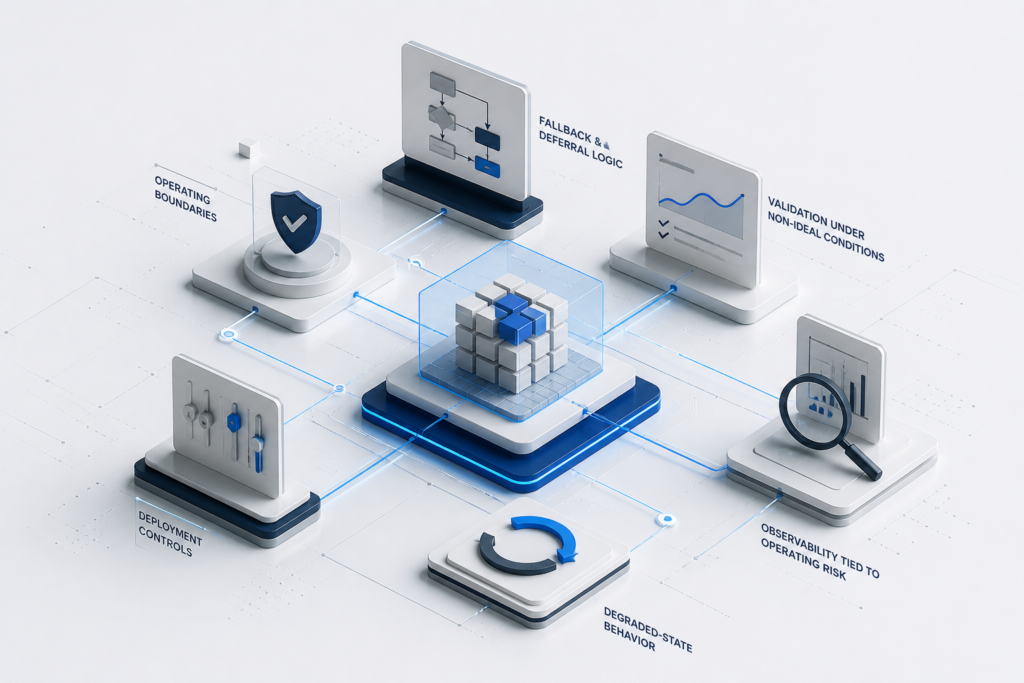
What XKALIUS is built to see
XKALIUS reviews the point where system behaviour and real operation stop matching cleanly.
The focus is not whether the system works in ideal conditions.
The focus is whether it can still be trusted, controlled and recovered when conditions become less clean.
XKALIUS looks for the boundary where:
- available data is not enough for confident action;
- system state is unclear when decisions depend on it;
- recommendations require repeated manual confirmation;
- operators are carrying uncertainty outside the system;
- recovery depends too much on specific people;
- escalation paths are not repeatable enough;
- readiness is assumed before the operating model can support it.
This is where risk becomes expensive.
Not always because the system fails.
Because more people, assets, workflows or decisions start depending on something that has not been technically understood under real conditions.
How XKALIUS works
XKALIUS does not start by assuming the system needs a full review.
The first step is to understand the operational boundary around the concern.
That may include:
- system context;
- relevant signals, outputs or logs where available;
- timing and state behaviour;
- operator checks or manual confirmation;
- fallback and recovery paths;
- escalation points;
- the decision the system is expected to support next.
The objective is not to collect everything.
The objective is to identify whether there is a real technical boundary behind the concern — and whether it is strong enough to act on.
For anonymised examples of reviewed scenarios and operational indicators, see Case Studies.
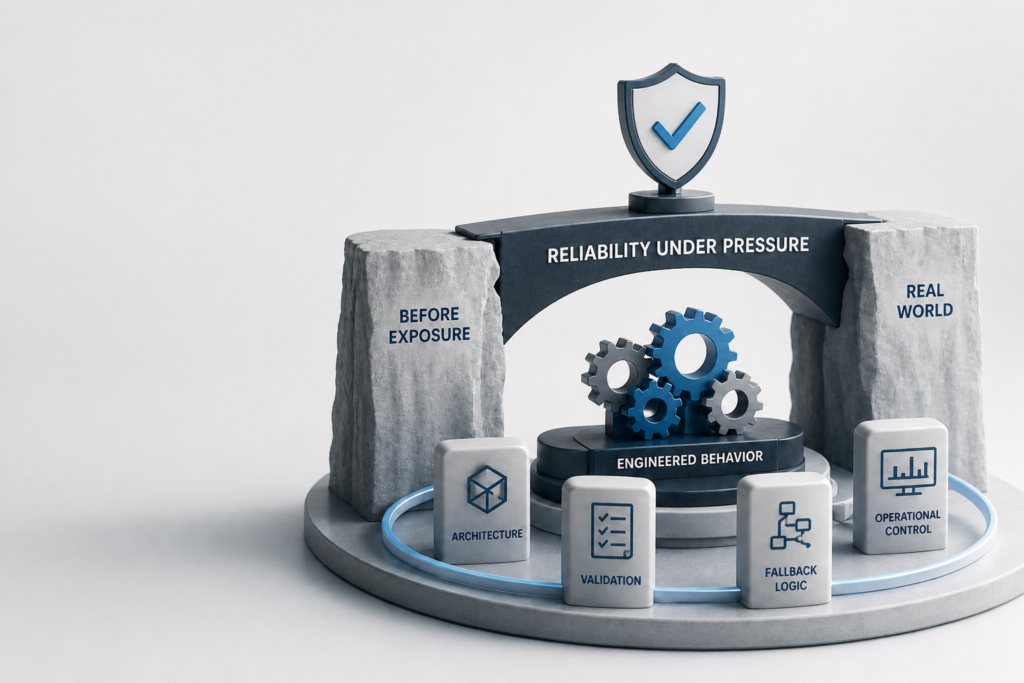

What changes when XKALIUS enters
XKALIUS does not come in to admire the architecture.
It comes in to make the operational problem actionable.
The work turns a vague concern into a clearer technical position:
What is actually weakening?
Trust, control, timing, recovery, visibility, escalation or readiness.
Where is the boundary?
The point where the system stops supporting the operation cleanly.
What should not be assumed yet?
The dependency that should not increase until the concern is understood.
What decision can now be made?
Continue, restrict, validate further, correct the boundary or stop exposure from increasing.
The value is not in producing another report.
The value is in making the next decision technically defendable.
Bring XKALIUS in before the system becomes something people work around
The right time to bring XKALIUS in is not after the system has already failed.
It is when the operation starts showing that something no longer fits cleanly.
Send a short description of the system, the concern and the decision in front of you.
XKALIUS will review the context and identify whether there is a real operational boundary to examine — or whether the concern is not strong enough yet.

Engineering decision systems to remain reliable under real operating pressure
NAVIGATION
Snapshot
Services
The Xkalius Method
Case Studies
Send System Context
Services
Operational Risk Snapshot
Trust Boundary Review
Fallback & Recovery Review
Operational Readiness Review
- @ 2026 XKALIUS
- Ingeniería para sistemas en los que el fallo no es teórico
© 2026 XKALIUS. All rights reserved.